
InfoNEXT 2026: From Conversation to Execution

ARMA InfoNEXT 2026 delivered. Three days in Phoenix brought strong conversations, meaningful engagement, and a clear signal. The industry is moving beyond policy. The focus is now on execution. Across sessions, hallway discussions, and client conversations, one theme came through consistently. Organizations are not struggling with what to do. They are struggling with how to operationalize it at scale. That is exactly what we set out to address in our session: “Order from Chaos: Real World Lessons Using AI-Enhanced Auto-Classification.” The Reality: Policy Is Not Enough As we highlighted early in the session, most organizations already have policies in place. But policy alone does not create control. Data continues to grow exponentially, and governance programs that live only in documentation cannot keep pace. The gap is clear: Bridging that gap is where the real work begins. What Is Changing (and What Is Not) AI is accelerating the conversation, but it is not replacing governance. As discussed in the session: Success comes from how AI is applied, not from the technology itself. One takeaway resonated strongly with attendees: AI does not fail. Poorly scoped problems do. What Actually Works The real-world case studies reinforced a consistent pattern: Whether working through ROT remediation, large-scale migrations, or complex classification challenges, the organizations seeing success are treating AI as an enabler within a structured governance framework. It is not a standalone solution. Missed the Session? If you were not able to attend, or want to revisit the details, we have you covered. Missed our presentation? Download it now: “Order from Chaos” Final Thought InfoNEXT confirmed what many of us are already seeing. The future of information governance is not about writing better policies. It is about connecting policy to data and making that connection operational, scalable, and defensible. That is where the real opportunity is. The information you obtain at this site, or this blog is not, nor is it intended to be, legal or consulting advice. You should consult with a professional regarding your individual situation. We invite you to contact us through the website, email, phone, or through LinkedIn.
One Week Later: Here’s What Still Resonates from ARMA InfoCon 2025
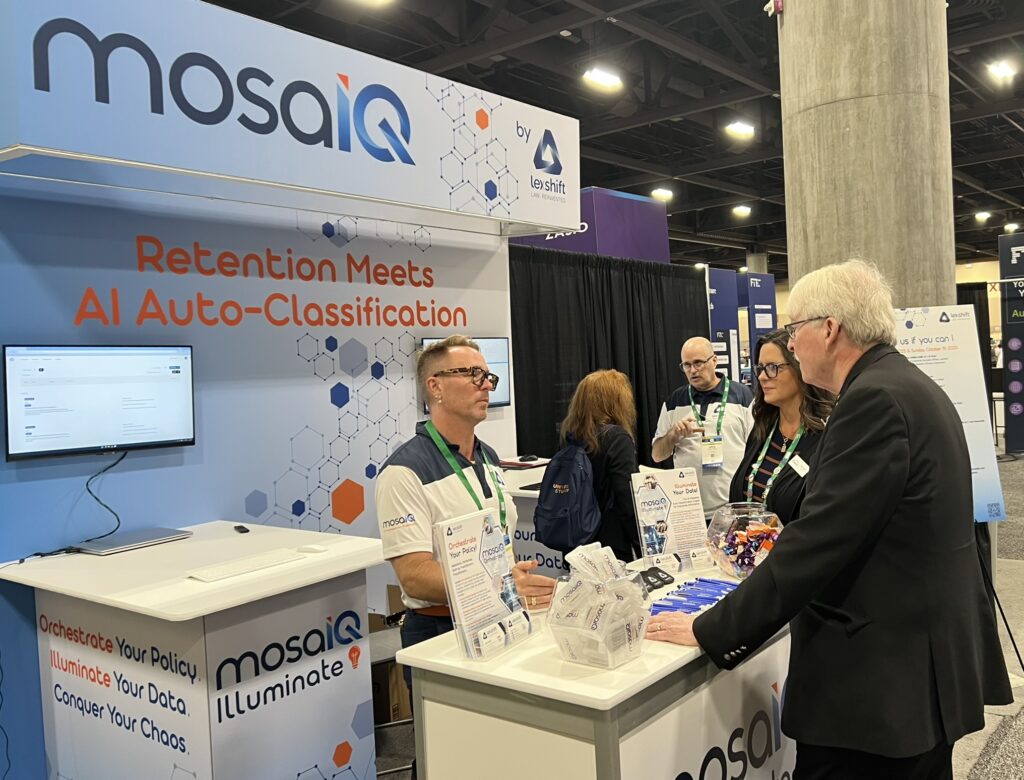
ARMA InfoCon 2025 marked a major milestone: 70 years of advancing the practice and profession of information governance. LexShift was honored to participate in this year’s conference with a full slate of workshops, panels, and roundtable conversations alongside industry peers and clients who continue to shape the future of IG. Throughout the week, several themes consistently emerged. While the challenges facing IG professionals remain, the way organizations are approaching them is clearly evolving. Below are five key takeaways from our sessions, client conversations, and our annual Client & Friends Breakfast Roundtable, which brought together professionals from both public and private sectors for a candid exchange of ideas. 1. Organizations Still Struggle to Define IG Across industries, many organizations continue to grapple with a fundamental question: what does information governance really mean? Too often, IG is viewed as a renamed version of records management. But there is an important distinction. Records management focuses on execution—maintaining compliance, applying retention, and managing the lifecycle of records. Information governance is strategic. It defines who is accountable, what policies apply, and how decisions align with business risk, regulatory frameworks, and enterprise value. At LexShift, we help organizations clarify this distinction and build governance models that align stakeholders around a shared understanding of purpose and accountability. 2. Executive Buy-In Remains a Challenge IG professionals continue to report difficulty securing meaningful and sustained executive support. While many business leaders support IG in principle, the value proposition is often unclear or misaligned with enterprise priorities. The takeaway is not that executives need to be educated, but that IG needs to be reframed in business terms. Governance enables operational efficiency, supports regulatory readiness, and reduces long-term legal and financial risk. LexShift’s advisory work focuses on helping IG teams position their work in ways that resonate with the C-suite and connect directly to organizational outcomes. 3. Retention Schedules Are Still a Sticking Point Retention schedules continue to present challenges. Many are outdated, siloed, or difficult to maintain. This was a recurring topic at both our conference sessions and our client breakfast discussion. Participants noted that while policy ownership is often well-defined, responsibility for updates and enforcement is less clear. Public sector teams cited staffing constraints as a major hurdle. In contrast, some private sector organizations reported success by empowering departments to take ownership of compliance, with the IG team serving as a policy steward rather than an enforcer. LexShift’s Orchestrate solution supports this model. It streamlines the development and maintenance of legally sound, business-aligned retention schedules that can be maintained in a collaborative, scalable way. 4. Operationalizing Retention Remains a Major Hurdle Even with up-to-date policies and retention schedules, applying them across diverse and fragmented data environments remains a significant challenge. Our roundtable participants shared varying experiences with electronic recordkeeping enforcement. Public sector teams reported gaps tied to staffing, while some private organizations have adopted a decentralized approach. One regional bank, for example, empowers departments to implement policy locally. The IG function simply provides the authoritative source and guidance. LexShift’s Illuminate helps address these issues by enabling organizations to identify, classify, and manage data in alignment with governance frameworks, improving both visibility and compliance across repositories. 5. The Role of IG Professionals Is Shifting One of the most thought-provoking conversations from our Client & Friends Breakfast focused on how the role of the IG professional is evolving. There was consensus that IG teams are responsible for managing records, regardless of format. But when it comes to digital records, public and private sector approaches vary significantly. In the public sector, lack of resources often limits enforcement capacity. In the private sector, some professionals see themselves as policy publishers, not policy enforcers. This shift reflects a broader trend. IG professionals are increasingly being asked to lead through influence, not control. As governance grows more distributed and embedded within business functions, success depends on clarity, accountability, and practical support—not central enforcement alone. Looking Ahead ARMA’s 70th anniversary is a reminder that while the terminology and tools have changed, the core goals of IG remain constant: clarity, defensibility, and accountability. What has changed is the environment. The complexity of modern data ecosystems requires a different approach—one that connects governance frameworks with operational realities and delivers real-world execution. At LexShift, we are committed to supporting that shift through practical consulting, flexible solutions like Orchestrate and Illuminate, and an ongoing dialogue with the IG community. To learn more about how we work or to connect with our team, visit lexshift.com/lexshift_staging/. The information you obtain at this site, or this blog is not, nor is it intended to be, legal or consulting advice. You should consult with a professional regarding your individual situation. We invite you to contact us through the website, email, phone, or through LinkedIn.
LexShift Will Be Taking Center Stage at ARMA InfoCon 2025
LexShift LLC, the company that features the MosaIQ suite of products, will be making a big splash at ARMA’s InfoCon 2025 this coming October 19 to 23. “I am pleased to report that we will be taking center stage at ARMA this year,” says John Isaza, the newly appointed COO at LexShift. “We have planned a dramatic roll-out that will feature not only a booth on the showroom floor, but also several educational sessions featuring the founders of our company.” In addition to educational sessions at the conference, LexShift will be conducting demonstrations of its two flagship products: mosaIQ Orchestrate and mosaIQ Illuminate. Orchestrate is a SaaS-based retention scheduling tool that includes access to retention and information governance regulations in 350+ global jurisdictions. It leverages artificial intelligence (AI) to track revised or new regulations, which are then mapped to the organization’s retention schedule based on its geographic footprint and bespoke operations. Illuminate offers on-prem AI-powered autoclassification of documents and records, capable of classifying over 8,000 records or documents per hour to the organization’s retention schedule. That translates to nearly 200,000 documents per day, which is not only humanly impossible but far more accurate than any human could ever imagine. Following is a detailed list of the LexShift-related educational sessions and product demonstrations at Booth 504 that will be featured during the conference: Saturday, October 18, 2025 & Sunday, October 19, 2025 9:00 AM – 5:00 PM Deep Dive into the ARMA IGIM v2.1 (2-Day), Jason Stearns, Chief Customer Success Officer Camelback A, Sheraton Phoenix Downtown Monday, October 20, 2025 9:30 AM – 3:45 PM Demo sessions for mosaIQ products Booth 504, Phoenix Convention Center 3:15 PM – 4:15 PM Data Privacy Around the World in 80 Seconds? Not So Fast!, John Isaza, Chief Operations Officer Location 129, Phoenix Convention Center Tuesday, October 21, 2025 8:30 AM – 9:30 AM Navigating Change: Understanding the Shift from ARMA’s Information Governance Implementation Model V 2.0 to V 2.1, Jason Stearns, Chief Customer Success Officer Location 125, Phoenix Convention Center) 9:00 AM – 3:45 PM Demo sessions for mosaIQ products Booth 504, Phoenix Convention Center 4:30 PM – 5:30 PM Don’t Be Left Holding the Bag: Targeted Strategies for Reasonably and Defensibly Scoping Legal Holds in the Age of Data Minimization, Jeffrey Sharer, Chief Executive Officer Location 129, Phoenix Convention Center Wednesday, October 22, 2025 10:30 AM – 11:30 AM From Influence to Implementation: Achieving Executive Buy-In to Advance Your IG Program, Jason Stearns, Chief Customer Success Officer Location 125, Phoenix Convention Center) The information you obtain at this site, or this blog is not, nor is it intended to be, legal or consulting advice. You should consult with a professional regarding your individual situation. We invite you to contact us through the website, email, phone, or through LinkedIn.